

Christian Heinis
Associate Professor
EPFL
Talk Information
New Fronteirs in Peptide Science
19 June 2025, 04:25pm - 04:50pm, in the Pacific Jewel Ballroom
L71 – Membrane-Permeable Cyclic Peptides Against Intracellular Targets and for Oral Delivery
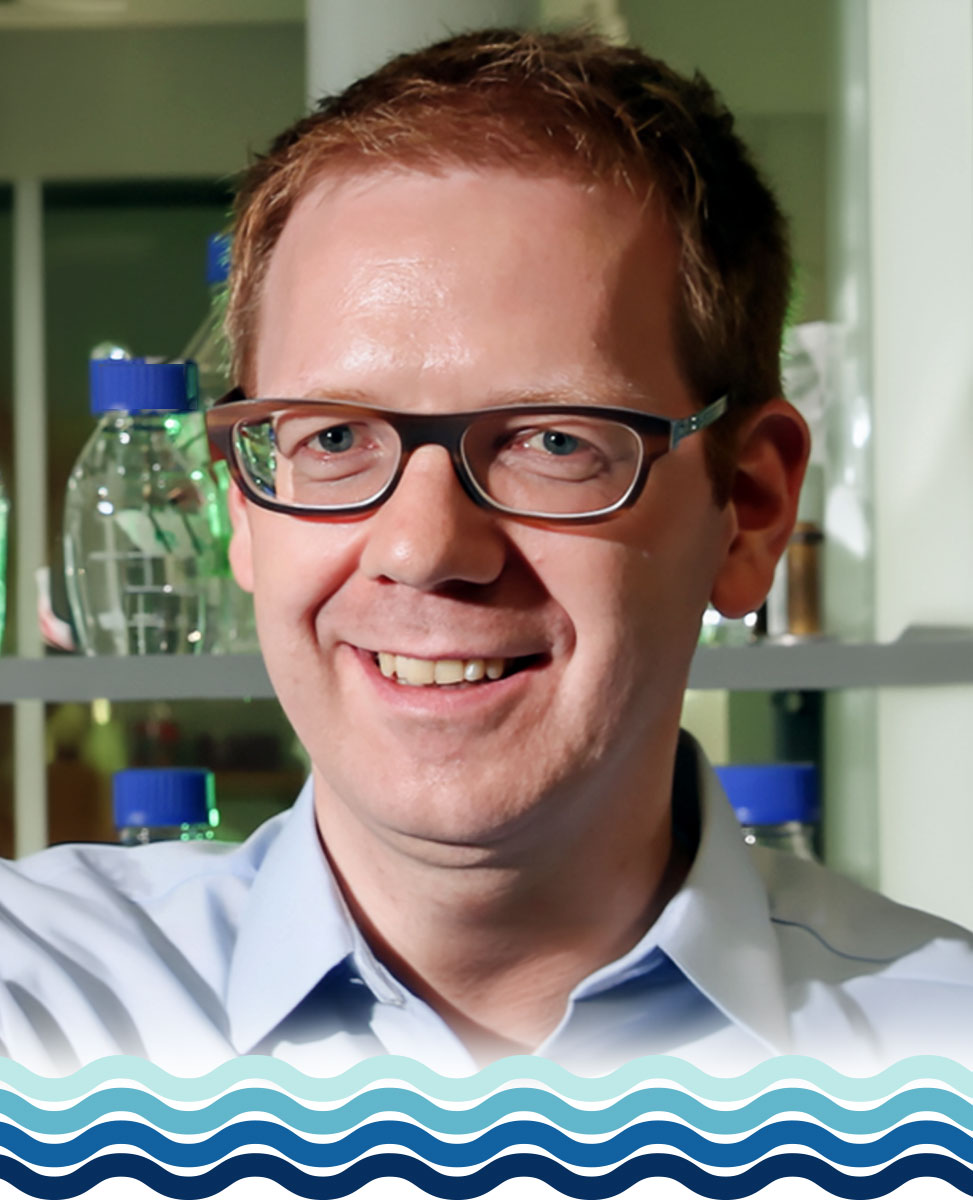
Dr. Christian Heinis is an Associate Professor of Chemical Biology at the École Polytechnique Fédérale de Lausanne, EPFL, where he leads the Laboratory of Therapeutic Proteins and Peptides. His research combines synthetic chemistry and molecular biology to design peptide-based therapeutics with improved stability, binding specificity, and bioavailability.
Academic Background
Dr. Heinis studied biochemistry at ETH Zurich, where he earned his Ph.D. under the supervision of Professor Dario Neri. He then pursued postdoctoral research at EPFL with Professor Kai Johnsson, followed by a fellowship with Sir Gregory Winter at the MRC Laboratory of Molecular Biology in Cambridge, UK. He joined EPFL as an Assistant Professor in 2008 and was promoted to Associate Professor in 2015.
Research Focus
Professor Heinis’s research focuses on the development of cyclic and bicyclic peptides as therapeutic agents. His team uses combinatorial chemistry to generate large peptide libraries and employs in vitro selection techniques to identify high-affinity ligands for medically relevant protein targets. A core objective of his lab is to develop peptides that are stable, cell-permeable, and orally bioavailable.
Notable Contributions
Dr. Heinis is a co-founder of Bicycle Therapeutics and Orbis Medicines, biotech companies dedicated to developing peptide-based drug candidates. His pioneering work in bicyclic peptide synthesis and screening has enabled new approaches to modulating “undruggable” targets, offering alternatives to traditional small molecules and antibodies.
Awards and Honors
Professor Heinis has received multiple prestigious awards, including a European Research Council, ERC, Advanced Grant for his work in merging synthetic and biologic compound libraries. His achievements have been recognized for advancing methods in therapeutic peptide discovery and development.
Professional Engagements
At EPFL, Dr. Heinis is involved in interdisciplinary teaching and research initiatives. He serves as co-director of the National Centre of Competence in Research, NCCR, Chemical Biology and contributes to its Steering and Education Committees. He also teaches graduate-level courses in biochemistry, drug discovery, and chemical biology.
Through his innovative research and translational efforts, Professor Christian Heinis continues to shape the future of peptide therapeutics and chemical biology.
Membrane-Permeable Cyclic Peptides Against Intracellular Targets and for Oral Delivery
Our laboratory is involved in the discovery and development of cyclic peptides for therapeutic applications. In recent years, we have begun to address the long-standing goal of developing target-specific peptides that are membrane-permeable and orally available. To this end, we are focusing on the generation of cyclic peptides that have a relatively small size, <1 kDa, and a limited polar surface area, so that they have a high chance of passively crossing membranes.
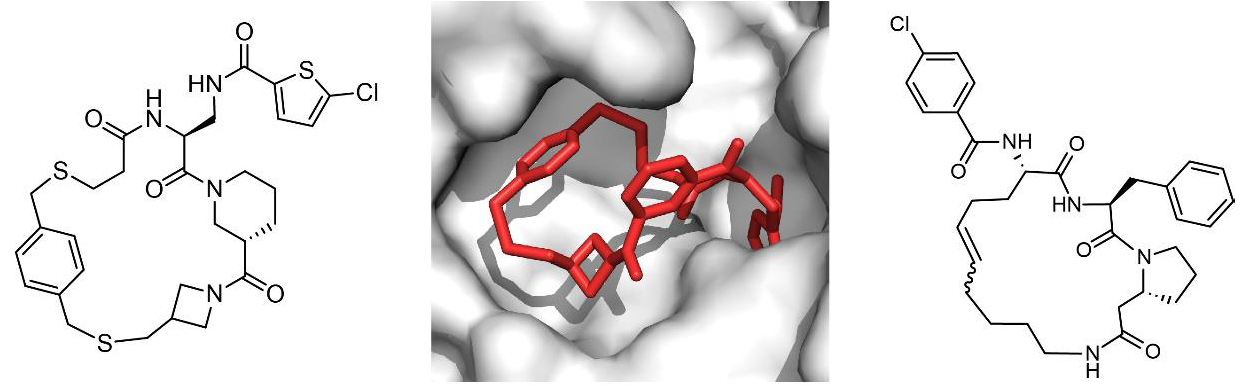
Figure: Structures of membrane permeable and orally available thrombin inhibitors identified by screening ten-thousands of random small synthetic peptides.
To generate sub-kilodalton cyclic peptides that bind to disease targets of interest, we have established an approach based on nanomole-scale cyclic peptide synthesis and high-throughput screening of crude products.1,2 In short, we generate thousands of peptides by solid-phase peptide synthesis and combinatorially diversify them by reacting them with a myriad of chemical building blocks. In this approach, all reagents are transferred in nanolitre volumes by acoustic dispensing and reactions are performed at the nanomole scale, allowing tens of thousands of cyclic peptides to be synthesized and screened in a short time. Recently, we have shown that cyclic peptides developed using this approach can achieve good oral availability.3
In my talk, I will explain the approach to the synthesis and screening of cyclic peptide libraries, show examples of libraries and their screening, present nanomolar ligands we have developed against different proteins. In addition, I will present recent learnings about the structure-membrane permeability of cyclic peptides.
1 S. Kale, et al., Science Advances. 2019, 5 (8).
2 S. Habeshian, et al., Nature Communications. 2022, 13 (3823).
3 M.L. Merz, et al., Nature Chemical Biology. 2024, 20 (5).